Author Archive

Week 7 Update — A $3 Billion Expansion — And What It Means for Virginia

March 3, 2026

Dear Friends,

This week the Senate voted on its version of Virginia’s two-year budget. After careful review, I voted no.

Budgets are never all good or all bad. There are always provisions worth supporting. The real question is whether the overall direction is sound — and whether the elements you oppose outweigh the ones you support.

This year, they did.

Three Budgets — Three Different Directions

This year we effectively considered three budgets:

1. Governor Glenn Youngkin’s introduced budget in December — a responsible plan I would have supported. It maintained fiscal discipline, included tax relief such as eliminating taxes on tips and overtime, and avoided dramatic expansion of long-term government commitments.

2. The House amendments, which added roughly $2 billion in additional spending compared to the Governor’s proposal and funded many Democratic priorities.

3. The Senate amendments, which added approximately $3.1 billion in net revenue increases, nearly a 10% increase over the introduced base.

It was the Senate version that came before us this week — and that scale of expansion made it impossible for me to support.

What Was Good — and Why It Wasn’t Enough

There were provisions in the Senate budget that I supported:

• A 3% teacher pay raise (passed 40–0 — I voted yes)
• An increase and extension of the standard deduction (40–0 — I voted yes)
• A one-time tax rebate (40–0 — I voted yes)

Those are positive steps.

But they were paired with structural changes and major revenue increases that move Virginia in a different direction.

The Senate budget reflects a deliberate decision to increase taxes and grow government at a substantial rate. That is not the direction I believe Virginia should take.

Legislative Pay — The Wrong Signal

Included in the Senate amendments was a near tripling of legislative pay — from $18,000 to $50,000 per year.

Public service is exactly that — service. At a time when proposals to eliminate the grocery tax and the car tax were rejected, dramatically increasing legislative salaries sends the wrong message.

Data Centers — Growth Follows Competitive Tax Policy

One of my deepest concerns is the elimination of the sales and use tax exemption for data centers.

Virginia became the global leader in data center investment because we adopted a stable, competitive tax structure that encouraged long-term capital investment.

Lower, predictable taxes encourage economic growth. That principle has been proven here. The exemption helped attract billions in private investment, strengthen our technology sector, and generate enormous local tax revenue.

Now that success is beginning to spread beyond Northern Virginia.

For years, data center development was concentrated in one region. Today, rural counties are finally positioned to compete for and attract this investment. A single data center campus in a rural locality can profoundly transform a county’s tax base — stabilizing tax rates, funding school construction, strengthening public safety, and reducing pressure on homeowners.

That kind of opportunity is rare.

Eliminating the exemption sends a message that Virginia is willing to change the rules midstream. Investment capital is mobile. Other states are aggressively competing for these facilities.

If we raise taxes on this sector, future investment will go elsewhere — and rural Virginia will lose the economic growth that is just beginning to reach it.

We should be expanding opportunity, not undermining one of the Commonwealth’s strongest engines of growth.

Key Floor Votes — Competing Visions on Taxes and Spending

There has been a great deal of rhetoric about “affordability.” On the Senate floor, we had clear votes on competing approaches.

Eliminate the Car Tax & Make Localities Whole
19 Republicans voted yes.
21 Democrats voted no.
I voted yes. It failed.

Eliminate the Grocery Tax & Make Localities Whole
19 Republicans voted yes.
21 Democrats voted no.
I voted yes. It failed.

Preserve Tax Relief on Tips and Overtime
Governor Youngkin’s introduced budget included this relief.
Senate Democrats removed it.

New Employer & Employee Payroll Tax
21 Democrats voted yes.
19 Republicans voted no.
I voted no. It passed.

Reinstate Carbon Tax (RGGI – Regional Greenhouse Gas Initiative)
21 Democrats voted yes.
19 Republicans voted no.
I voted no. It passed.

Remove the College Tuition Cap
21 Democrats voted to repeal it.
I voted to keep the cap.

New 11% Tax on Guns and Ammunition
21 Democrats voted yes.
19 Republicans voted no.
I voted no. It passed.

If we are serious about affordability, eliminating the car tax and grocery tax would have delivered immediate relief to Virginia families. Those proposals were rejected.

Redistricting Referendum — Partisan Gerrymandering at Its Worst

Early voting begins Friday, March 6.

In 2020, Virginians voted by a two-to-one margin to take partisan politics out of redistricting and enshrine protections in our Constitution. That vote was clear and decisive.

What is being proposed now reverses that decision.

This is partisan gerrymandering at its worst.

Democrats have openly celebrated maps designed to produce a 10–1 congressional delegation — that’s 10 Democrats and 1 Republican — in a state where statewide elections are often closely divided. That is not balance. That is not competition. That is politicians selecting their voters instead of voters selecting their representatives.

Even more troubling, maps were circulated by Democrat map drawers with specific names attached to particular districts — signaling which candidates the lines were drawn to favor. When districts are crafted with individual candidates in mind, the process is no longer about representation. It is about predetermining outcomes.

Virginians rejected that approach in 2020.

Now we are being asked to suspend the very constitutional protections voters demanded just a few years ago.

I strongly encourage you to vote early beginning March 6 and encourage friends and family to vote as well.

There are still negotiations ahead between the House and Senate before a final budget reaches the Governor. I will continue fighting for lower taxes, reliable energy, fiscal discipline, economic growth, and constitutional protections for Virginians.

As always, I appreciate the privilege of serving you.

Sincerely,

Mark Obenshain 

Virginia State Senate

The General Assembly Week 6 Wrap Up

February 22, 2026

Dear Friend,

We have now passed crossover in the 2026 General Assembly session. At this point, the contrast could not be clearer.

Senate Republicans pushed real, immediate relief for Virginia families. The majority blocked it — and instead advanced mandates, new taxes, and long-term cost increases.

Here is where things stand.


Real Relief Blocked

Republicans introduced direct, measurable tax relief:

  • Preserving the expanded standard deduction
  • Repealing the grocery tax
  • Eliminating taxes on tips and overtime
  • Repealing the car tax
  • Repealing the Virginia Clean Economy Act to reduce power bills

Taken together, these proposals would have saved the average Virginia family thousands of dollars.

Every one of them was killed.

Instead, the majority is advancing policies that increase costs across nearly every sector of the economy.


The “Affordability” Agenda That Raises Costs

Despite the branding, the following measures expand mandates and payroll taxes:

  • Minimum wage expansion (SB1)
  • Agricultural minimum wage mandate (SB121)
  • Statewide paid family leave payroll tax (SB2)
  • Paid sick leave mandates (SB199, SB372)
  • Collective bargaining expansion (SB378)
  • Prevailing wage mandates (SB518)
  • Appliance and water-use mandates (SB256)
  • A new 1% sales tax

Collective bargaining alone has the potential to significantly increase state and local labor costs — and those increases ultimately land on homeowners and taxpayers.

The paid family leave bill establishes a permanent payroll tax structure. That is not short-term relief. That is a long-term cost commitment.


Data Centers & Energy: A Self-Inflicted Shortage

There is ongoing debate in Richmond about data centers and power demand. Let’s be clear about the real issue.

Virginia should not have an energy supply shortage.

The strain on generation capacity is largely a self-inflicted problem created by the Virginia Clean Economy Act and other renewable mandates that artificially restrict reliable generation while forcing utilities toward intermittent sources. When dependable supply is constrained and demand continues to grow, shortages are predictable.

That is not the fault of data centers.

Virginia is the global leader in data center development. That leadership has fueled enormous economic growth and tax revenue. Loudoun County alone now collects over $1 billion annually from data center-related revenue. It has transformed the county’s fiscal position.

If Loudoun or Prince William County decide they do not want additional facilities, that is their choice. Land use decisions belong at the local level.

But many counties across Virginia would welcome a fraction of that revenue and have appropriate locations for this kind of development.

The answer is not to kill the goose that has laid golden eggs for Virginia’s economy. The answer is to restore reliable energy policy so supply keeps pace with demand — and allow localities to make their own land-use decisions.


Firearms

A sweeping gun-control package has advanced:

  • SB749 – Assault weapons ban
  • SB643 – Raises minimum age to 21
  • 10% tax on firearms and ammunition
  • SB27 – Expands civil liability for manufacturers and dealers

These measures burden law-abiding Virginians rather than focusing on repeat violent offenders.


Redistricting: Selected, Not Elected

This week brought one of the most troubling revelations of the session.

A report revealed that congressional maps drawn by House Democrats reportedly included the names of the candidates for whom each district was drawn.

When the measure came up for a vote, I asked a simple question: If transparency was promised, why are voters not being told who these districts were drawn for before they are asked to approve the maps?

No answer.

That is the definition of gerrymandering — politicians selecting their voters instead of voters selecting their representatives.

Selected, not elected.

Spread the word – VOTE NO on April 21.


The Bottom Line

At crossover, the record is clear:

  • Real tax relief blocked
  • New payroll taxes advancing
  • Expanded mandates and litigation
  • Political maps drawn with candidates in mind

This is the so-called “affordability” agenda being served up by Governor Spanberger and her Democrat allies who now control the General Assembly. I will continue fighting for reliable energy, lower taxes, fiscal restraint, constitutional freedoms, and local control.

As always, I welcome your thoughts. If you are in Richmond, please stop by the office.

Sincerely,

Mark Obenshain 

Virginia State Senate

The General Assembly Week 5 Wrap Up

February 16, 2026

Dear Friends,

We are approaching the midpoint of the 2026 General Assembly session, commonly referred to as “Crossover,” when each chamber must complete work on its own bills before they move to the other body.

This week, I am pleased to report on several of my bills that have cleared the Senate — each focused on protecting those who cannot always protect themselves.

Protecting Nursing Home Residents – SB535
SB535 strengthens protections for nursing home residents and holds facilities accountable for neglect and abuse. Our seniors deserve dignity, safety, and proper care. This bill reinforces those basic standards.(Passed Senate 40-0)

Protecting Children – SB778
SB778 increases safeguards against sexual predators targeting children. It closes gaps in current law and strengthens penalties to ensure predators are held accountable. (Passed Senate 40-0)

Protecting Elders from Financial Exploitation – SB540
SB540 enhances tools to prevent and prosecute financial exploitation of older Virginians. Scammers who prey on seniors’ life savings must face real consequences. (Passed Senate 40-0)

These are common-sense measures rooted in a simple principle: protect the vulnerable and enforce the law.

REDISTRICTING UPDATE: THE FIGHT IS FAR FROM OVER

In 2020, Virginians overwhelmingly approved a constitutional amendment creating a bipartisan redistricting commission to remove partisan map-drawing from the General Assembly.

Now, Democrats are attempting to sidestep the very guardrails voters put in place — including the statutory requirements in § 24.2-304.04 that districts be compact, contiguous, and not drawn to unduly favor a political party.

This effort to dismantle the nonpartisan redistricting system is still being challenged in court.

A Virginia Circuit Court ruled that Democrats violated multiple legal requirements in advancing the constitutional amendment to repeal the commission and held that the referendum should not proceed. That ruling is now on appeal to the Supreme Court of Virginia.

This week, the Supreme Court announced that it will allow the referendum to move forward on April 21. That is not a ruling on the merits. It is a practical decision. Canceling a statewide vote cannot easily be undone. Much like officials allowing a disputed play to run its course before review, the Court is permitting the process to continue while it considers the legal issues.

That means Virginians will go to the polls on April 21 to vote on whether to undo the bipartisan redistricting reform they overwhelmingly approved in 2020 — even though the legality of how this amendment was advanced remains under active review.

On April 21, Virginians will decide whether to preserve the reform they approved — or return the power to draw congressional districts to partisan politicians in Richmond.

This vote matters. It will determine whether the rules are applied fairly to both parties or rewritten when they become inconvenient. I encourage you to study the issue carefully and make your voice heard at the ballot box on April 21.

A WAVE OF OVERREACHING GUN BILLS

This week and last, the Senate considered — and in most cases passed — a series of sweeping gun-control proposals. None of them target criminals. All of them burden law-abiding citizens.

SB763 — 10% Firearms and Ammunition Tax
One bill would impose a 10% tax on all firearms and ammunition — on top of the existing 5% sales tax. This is not a “sin tax.” It is a penalty on responsible gun owners. (Passed Senate 21-19)

SB348 — Mandatory Biometric Safe Storage in Homes
Another proposal would require firearms in homes to be stored in a locked gun safe. The initial version of the bill required storage in biometric safes, despite existing tax credits helping citizens purchase gun safes that would not qualify under the proposed requirements. (Passed Senate 21-19)

SB496 — Unattended Vehicle Storage Mandates
A proposal creates new criminal penalties for firearm storage in unattended vehicles. An amendment requiring containers to be welded or steel-cabled to the vehicle frame failed, but the underlying bill passed. The result is an overly prescriptive law that may discourage honest reporting of stolen firearms if citizens fear they could face prosecution for a violation. (Passed Senate 21-19)

SB27 — Lawsuits Against Manufacturers and Retailers
Another bill would expand lawsuits against firearm manufacturers and sellers when a third party misuses a firearm, inviting litigation against lawful businesses. (Passed Senate 21-19)

SB643 — License to Purchase Any Firearm
A sweeping proposal would require a government-issued license before purchasing any firearm, with fingerprinting, live-fire and “conflict resolution” training, database tracking, and fees estimated between $200 and $300, with renewals every five years. (Pending Senate vote)

SB749 – The “Assault Weapons” Ban
The Senate has passed SB749, banning commonly owned semi-automatic firearms, and the bill is on its way to the House. I spoke in opposition (Link). The legislation criminalizes firearms based largely on cosmetic features — what they look like, not what they do. These firearms fire one round per trigger pull, like many lawful sporting firearms. Banning them will not reduce crime but will penalize law-abiding Virginians. (Passed Senate 21-19)

LOOKING AHEAD

This week, both the House and Senate will release their respective budget proposals. That will tell us a great deal. We will see whether the Governor and her allies intend to live within the multi-billion-dollar surplus Virginians have already provided — or whether the plethora of new tax proposals introduced by Democrats this session quietly reappear in the budgets.

We are also hearing that some of the Democrats most expensive initiatives may be structured so the real costs do not take effect during this two-year budget cycle, but only after the 2027 General Assembly elections. If true, that would mean asking voters to render judgment before the financial consequences ever arrive. Virginians deserve transparency about not only what these proposals cost — but when the bill will actually come due.

A CLEAR CONTRAST

The contrast in priorities is unmistakable.

My Republican colleagues and I are advancing legislation to protect seniors, protect children, and protect constitutional rights. We are fighting to keep taxes low and energy affordable.

Meanwhile, our new Governor and her legislative allies continue to push a polarizing agenda — redrawing congressional districts, expanding government mandates, and advancing gun control proposals that burden law-abiding citizens instead of criminals.

As we move into the second half of session, these debates will intensify. I will continue standing firm for limited government, fiscal responsibility, and the constitutional freedoms that define our Commonwealth.

If you have thoughts, concerns, or suggestions, I want to hear from you. If you are in Richmond during session, please stop by the office.

It is an honor to serve you.

Sincerely,

Mark Obenshain 

Virginia State Senate

The General Assembly Week 4 Wrap Up

February 16, 2026

Dear Friend,

As we enter the fourth week of the 2026 General Assembly session, I want to provide my legislative report on what is happening in Richmond. Governor Spanberger campaigned as a moderate and made “affordability” her central promise. The actions we are now seeing—by the Governor and her Democratic allies in the General Assembly—tell a very different story.

This is an affordability bait-and-switch.

RGGI: A Back-Door Carbon Tax

In her first State of the Commonwealth address, the Governor announced that Virginia will be forced back into the Regional Greenhouse Gas Initiative (RGGI). RGGI is a multistate cap-and-trade program that operates as a back-door carbon tax, with the stated goal of reducing emissions by 86 percent by 2037, regardless of cost or reliability.

According to the Thomas Jefferson Institute for Public Policy, re-entering RGGI will cost Virginia electric customers approximately $500 million every year in higher power bills. That burden will fall directly on families and small businesses—at the same time Virginia is struggling to meet rising electricity demand from data centers and advanced manufacturing.

Immigration: Ending Cooperation with ICE

On immigration, the Governor has aligned Virginia with the national progressive agenda. She ordered state police and corrections agencies to terminate all cooperation agreements with federal Immigration and Customs Enforcement.

This is not moderation or bipartisan governance. It is ideological posturing that abandons cooperative federalism and undermines public safety.

Redistricting: Reversing the 2020 Voter Mandate

Redistricting represents one of the most cynical and hypocritical political moves in modern Virginia history. On November 3, 2020, Virginia voters overwhelmingly approved a constitutional amendment creating a bipartisan redistricting commission, explicitly rejecting partisan gerrymandering and demanding fairness and transparency in the process. That vote was clear, recent, and decisive.

Now—barely five years later—the Governor and Democratic leadership are backing a constitutional amendment designed to blow up that bipartisan system and return redistricting power to the General Assembly for raw partisan advantage.

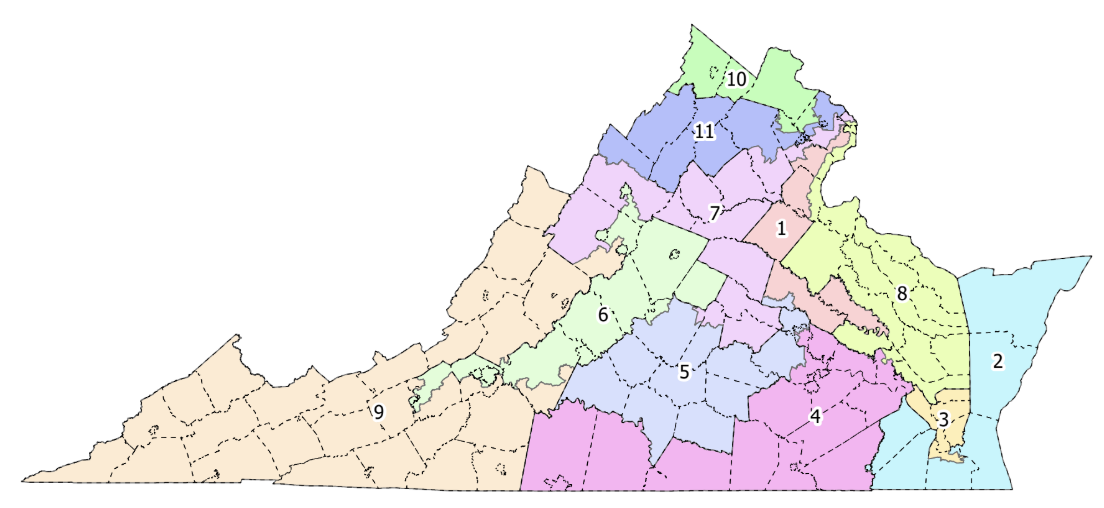
Last Thursday night, Democrats released a proposed congressional map that confirms exactly what this effort is about. The districts are anything but compact and bear no resemblance to communities of common interest.

2026 Democrat Proposed Congressional Map:

Rockingham County alone is split into three different congressional districts, and northern Rockingham is shoved into a district that stretches all the way to the Potomac River near Washington, D.C. This is gerrymandering, plain and simple—and a direct slap in the face to Virginians who were told in 2020 that partisan map-drawing was over.

Higher Education: Politicizing Virginia’s Institutions

Higher education has also become a battleground. While the Governor herself did not initiate it, her legislative allies have launched an ongoing campaign against the Virginia Military Institute, the oldest state-supported military college in America and one of the most distinguished military academies in the nation.

VMI’s alumni include George Patton, George Marshall, and numerous Medal of Honor recipients. Yet we are now seeing open hostility toward the institution’s mission, traditions, and leadership—boards at UVA and George Mason University are being politicized, and divisive DEI bureaucracies are being revived across higher education.

Taxes: A Wish List of New Burdens

The tax agenda may be the clearest example of the bait-and-switch. Despite a $2.7 billion budget surplus, Democrats have rolled out what can only be described as a wish list of new taxes. These include higher income-tax brackets, a new tax on investment income, and a statewide paid family and medical leave program funded by a new payroll tax.

Under current estimates, a two-income family would pay more than $500 per year in new payroll taxes alone, not including the employer share—which will inevitably be passed back to workers through lower wages, higher prices, or both.

As the Washington Post recently noted, Virginia is not suffering from a revenue shortage. Income tax collections have exceeded projections year after year, taxpayers have received rebates, and the Commonwealth maintains a multi-billion-dollar rainy-day fund.

Democrats insist that because not every tax proposal has passed yet, critics are exaggerating. That argument is not credible. These proposals did not appear by accident. They are part of a broader plan—and any that do not pass this year will be back in future sessions.

Right-to-Work: Being Gutted in Practice

Finally, while the Governor claims she does not support a full repeal of Virginia’s Right-to-Work law this year, she and her Democratic allies are gutting it in practice.

They are advancing statewide collective bargaining mandates and prevailing-wage laws that will balloon local government budgets, drive up real estate taxes, and significantly increase the cost of building schools and colleges—raising the cost of higher education itself.

There is nothing affordable about any of this.

Virginians were promised moderation, bipartisanship, and affordability. What we are getting instead is a progressive agenda that raises costs, centralizes power, and disregards the clear will of the voters.

I will continue fighting these policies and standing up for common sense, affordability, and honest government. As always, I welcome your thoughts—and if you are in Richmond during session, please stop by my office.

Further Reading

  • Wall Street Journal editorial on Governor Spanberger’s early agenda: [Link]
  • Washington Post editorial on Virginia’s surplus and proposed tax hikes: [Link]
  • Virginia Mercury article detailing Democrats’ proposed tax increases: [Link]

Sincerely,

Mark Obenshain 

The General Assembly Week 3 Wrap Up

February 2, 2026

Dear Friend,

Week three of the General Assembly session has concluded, and I want to share an update on what is happening in Richmond.

Common-Sense Bills Blocked
Once again, Senate Democrats blocked a series of practical bills that would have lowered costs, strengthened public safety, and respected taxpayers. Among them was SB 78, which would have increased mandatory minimum sentences for repeat firearm offenders—targeting violent criminals who repeatedly break the law. Instead of advancing that bill, the Democratic majority chose to stop it.

Other blocked measures would have repealed costly mandates on small businesses, reduced taxes, restored commonsense election safeguards, and eliminated the car tax. These proposals were aimed squarely at affordability and public safety. They were rejected nonetheless.

Gun Bills: Burdening the Law-Abiding
While refusing to get tougher on repeat violent offenders, Democrats are advancing a slate of gun bills that primarily burden law-abiding Virginians rather than addressing criminal misuse of firearms.

  • SB 749 bans a wide range of commonly owned semi-automatic rifles, pistols, and shotguns.
  • SB 348 imposes mandatory firearm storage requirements in homes where minors or prohibited persons reside, creating criminal liability for otherwise responsible gun owners.
  • SB 312 prohibits the carrying of so-called “assault firearms” in broad categories of public places.
  • SB 496 restricts the ability of law-abiding individuals to keep a firearm in their vehicle for self-defense.
  • SB 115 jeopardizes concealed handgun permit recognition and long-standing reciprocity agreements with other states.
  • SB 643, introduced by the Senate Majority Leader, would require Virginians to obtain a government-issued license before purchasing a firearm. The bill imposes onerous prerequisites—including mandatory training unrelated to firearms safety, such as “conflict resolution” courses—creating yet another barrier for law-abiding citizens exercising a constitutional right.

Taken together, these bills do little to stop violent crime. Instead, they expand restrictions, create new technical violations, and impose additional burdens on citizens who already follow the law—while ignoring the real problem: repeat violent offenders.

Redistricting Update
This week, Republicans secured an important court victory challenging Democrats’ attempt to rush a redistricting constitutional amendment through the 2024 Special Session. The court ruled that the General Assembly failed to comply with its own Special Session rules and did not meet constitutional and statutory requirements, rendering those actions legally invalid.

The court also found that the required intervening House election has not yet occurred, because early voting for the 2025 election began before the amendment passed. As a result, the earliest lawful election that could satisfy constitutional requirements would be 2027. The court further concluded that Virginia’s public notice requirements were not followed, undermining claims that the amendment received proper second passage.

Democrats have appealed the ruling, and the case now moves to the Court of Appeals. The fight is not over, and we will continue opposing this effort to impose a mid-decade, partisan gerrymander on Virginia.

Affordability Promises vs. Reality
The Governor has spoken often about affordability and has promised a bipartisan, unifying approach. Unfortunately, the legislative agenda so far reflects something very different.

Instead of lowering costs, Democrats are advancing a growing list of new and expanded taxes and fees that fall directly on working families and small businesses, including:

  • A new local sales tax in all Virginia counties and cities
  • New income tax brackets
  • A delivery tax on services such as Amazon, FedEx, UPS, and food delivery
  • A rideshare tax on Uber and Lyft
  • New taxes on storage units, gym memberships, and vehicle repairs
  • New taxes on home repairs and dry cleaning
  • New taxes on personal and professional services, including counseling and pet services
  • A tax on digital products such as Kindle and other electronic media

This stands in sharp contrast to the rhetoric about affordability coming from the administration and Democratic leadership.

What’s Coming in Commerce & Labor
This week, the Commerce and Labor Committee will consider legislation that will further raise the cost of living for working Virginians, including:

  • Minimum wage increases
  • New insurance mandates
  • Prevailing wage legislation
  • Additional labor and regulatory requirements on employers

These are not modest or incremental changes. They are progressive, costly proposals that would significantly increase the cost of doing business in Virginia, drive up already high insurance premiums for families, and impose new burdens on employers, manufacturers, and other job creators. Taken together, they threaten business growth, job opportunities, and the ability of working Virginians to keep up with the rising cost of living.

Energy Reliability Still Matters
Recent winter weather once again demonstrated the importance of reliable, affordable energy. Virginians kept the lights on because of dependable generation like natural gas and nuclear—not intermittent sources that cannot meet demand during peak conditions. Republicans remain committed to repealing the Virginia Clean Economy Act and restoring a reliability-first energy policy.

I appreciate hearing from constituents and welcome your thoughts and concerns. And if you are in Richmond during the session, please feel free to stop by my office.

Sincerely,

Mark Obenshain 

The General Assembly Week 1 Wrap Up

January 20, 2026

Dear Friends and Neighbors,

I want to update you on some of the very first actions taken by the new Democratic majority in the General Assembly and by Governor Spanberger—and why they matter to families and employers across Virginia.

Partisan Constitutional Amendments

One of the majority’s first moves was to fast-track four constitutional amendments for the ballot, likely this April. These are not modest or bipartisan proposals. They are sweeping, ideological changes—three of them focused on divisive social issues.

Most notably, the abortion amendment would create a fundamental constitutional right to abortion in Virginia. That goes well beyond Roe v. Wade and would almost certainly be used to strike down laws that enjoy broad public support, including parental consent and parental notification requirements. Virginians should understand that once a policy is embedded in the Constitution at this level, it becomes extremely difficult—if not impossible—to rein in through normal legislation.

There is also a redistricting amendment that deserves close scrutiny. Just three years ago, an overwhelming majority of Virginians voted to take politics out of redistricting. Now, in a strikingly ironic and purely political maneuver, Democrats are moving to undo that decision. Their own supporters have openly claimed this amendment could be used to redraw Virginia’s congressional districts to produce a 10–1 Democratic majority in our congressional delegation. All of this is happening while the same leaders tell Virginians their focus is affordability—a claim that rings hollow when paired with an aggressive effort to entrench political power.

Governor Spanberger’s “Task Force” Orders

Governor Spanberger also signed a series of executive orders creating task forces to study affordability—health care, housing, and other costs that are already squeezing Virginia families.

Frankly, this is surprising. The Governor spent more than a year campaigning almost exclusively on affordability. Virginians reasonably expected concrete proposals on day one—not a decision to appoint task forces to figure out what to do after the election.

The disconnect becomes even clearer when you look at what Democratic legislators are already advancing.

An Agenda That Raises Costs

At the same time these task forces are being formed, Democrats have introduced legislation that would raise costs across the board for workers, families, and small businesses, including proposals to:

  • Mandate a $15/hour minimum wage, increasing labor costs for small employers
  • Create paid sick leave and paid family leave programs funded by more than $2 billion in new taxes
  • Impose a $1.4 billion income tax increase on higher earners
  • Expand sales, digital, and services taxes—amounting to billions more in new revenue
  • Repeal Right-to-Work, forcing workers to pay union dues and increasing the cost of doing business in Virginia

It is hard to reconcile the creation of “affordability task forces” with an agenda that so clearly moves in the opposite direction.

Republican Solutions That Deliver Real Relief

By contrast, Senate Republicans have already introduced common-sense legislation that would make an immediate, measurable difference in your household budget—ideas that might actually be worth studying by those task forces. These include:

  • Repealing the Virginia Clean Economy Act, saving families more than $1,000 per year in energy costs
  • Eliminating taxes on tips, returning an average of $280 per worker
  • Eliminating taxes on overtime pay, saving about $130 per worker
  • Repealing the car tax, putting roughly $1,099 back into the average household
  • Repealing the grocery tax, saving families hundreds of dollars each year
  • Extending the higher standard deduction, saving up to $600 per family

These proposals are straightforward, practical, and focused on one goal: letting Virginians keep more of what they earn.

As always, I welcome your thoughts, concerns, and suggestions. If you are in Richmond during the General Assembly session, please feel free to stop by my office. I value hearing directly from the people I represent.

Sincerely,

https://stratus.campaign-image.com/images/mark_zc_v3_938000077130004.jpg

Mark Obenshain 

Obenshain Letter to Sentara RMH Regarding Pediatric Unit Closure

September 20, 2024

September 19, 2024

Gov. Youngkin visits Shenandoah Valley to sign bills and give donations

August 16, 2024

By Mair Famet

Published: Aug. 16, 2024 at 7:11 AM EDT|Updated: 1 hour ago

HARRISONBURG, Va. (WHSV) — Gov. Glenn Youngkin made his way to the Friendly City on Thursday, stopping at James Madison University (JMU) for a quick bill-signing ceremony and the Rockingham County Fair to donate a portion of his salary to organizations.

During an event at Anthony Seeger Hall, Youngkin signed the Building Blocks for Virginia Families Initiative. The bill was described as a “significant investment” in the state’s early learning programs and childcare options for working parents.

The new funding replaces expired federal dollars that expanded childcare programs during the COVID-19 pandemic.

Youngkin said the initiative gives working parents a sense of autonomy.

“[For families] to decide how they want to use their childcare, that is so exciting, so that we can then make sure that we are targeting the funding — [the] $1.2 billion over the course of the next two years across the Commonwealth — to the right kinds of programs to support parents need,” Youngkin said.

After the signing, Youngkin made his way to the Rockingham County Fair, where he donated a portion of his gubernatorial salary ($21,875 to both) to the Farm Ministry and the Rockingham County Fair.

The CEO of the Farm Ministry said the money donated to the ministry will feed more than 4,300 families in Virginia.

The donation to the Rockingham County Fair will be used to build a new barn.

Ultimately, Youngkin acknowledged the agriculture industry, applauding the spirit of Virginians, especially during the drought season.

“The spirit of Virginians is alive and well across this Commonwealth because it is amazing to see Virginians go to work every single day,” Youngkin said.

Copyright 2024 WHSV. All rights reserved.

Skip AdDiscover

5 Habits to Break When Booking FlightsAAA|

Sponsored

Amazon’s Worst Nightmare: Thousands Canceling Prime for This Clever Hack (It’s Unbelievable)Online Shopping Tools|

Sponsored

Chuck Norris: Do This Once A Day If You’re Over 60 And You’ll Feel Years YoungerRoundhouse Provisions|

SponsoredWatch Now

Amazon’s Worst Nightmare: Thousands Canceling Prime for This Clever HackThis simple trick can save tons of money on Amazon, but most Prime members are ignoring it.Coupon Code Finder|

Sponsored

5 Legal Discounts Seniors Get Only If They AskSeniorDealToday|

Sponsored

Virginia Launches New Policy for Cars Used Less Than 50 Miles/dayBindright|

Sponsored

These Barefoot Shoes are Leaving Neuropathy Experts BaffledBarefoot Vitality|

Sponsored

Mortgage Rates are Finally Falling. Lock in a Lower Rate TodayNerdWallet|

SponsoredLearn More

7 Wealth Tips Once Your Portfolio Reaches $1 MillionHow do retirees take steps to preserve their wealth in retirement? Download The Seven Secrets of High Net Worth Investors now.Fisher Investments|

SponsoredLearn More

Seniors To Receive 7 Big Benefits This Month If They AskSeniors discounts that most seniors have never heard of.NationalPenny|

SponsoredClick Here

https://01582edcb978b3b7e99bd08b603ac78b.safeframe.googlesyndication.com/safeframe/1-0-40/html/container.html

Most Read

Sheetz went missing while hiking in Pendleton County three and a half years ago. She was last...
 W.Va. State Police prepares to close Cassie Sheetz case with no charges filed, pending DNA results
FILE - In this April 28, 2015, file photo, Matthew Perry arrives at the LA Premiere of "Ride"...
 5 people, including 2 doctors, charged in connection to Matthew Perry’s death, authorities say
Just before 9 a.m. Thursday, a pursuit on I-95 in Northern Virginia ended after a car crashed...
 Baby at center of Va. Beach AMBER Alert dies in Maryland crash
Frederick County Sheriff's Office is working to identify human remains found in a creek.
Sheriff working to identify skeletal remains found in Frederick County
Niquella Madden is charged with one count of stealing a pre-retail medication in federal court...
 Former pharmacist-in-training accused of stealing pills from Walmart
Patriotic Pretzels by Palmer Candy Co. are among the products being recalled because of...
Dozens of candy and snack products sold at Walmart, Target, Dollar General recalled for possible salmonella contamination
After the hit, this is Dustin Atkin's wall surrounding his driveway.
Amazon delivery driver causes damage to Staunton man’s home, no fix 8 months later
A neighbor says he heard six gunshots right after the victim arrived home.
 Juvenile arrested in connection with deadly shooting

Latest News

A man is dead following a single-vehicle crash on Dinkel Avenue in Bridgewater.
 Name released of man who died after single vehicle crash at Bridgewater College
Kayla is live at the fair previewing the Market Sale.
Will Kayla be “baaack” at the Fair next year?
Young animal shower discusses why it's important for people to show interest in farming.
Rockingham County Fair: 8-year-old Jack on why farming is important
 Harrisonburg Police Department warns about vape products targeting kids
Countdown to EndZone: Strasburg
Harrisonburg Police Department warns against vaping devices targeting kids
HARRISONBURG, Va. (WHSV)—Governor Glenn Youngkin made his way to the friendly city on...
Gov. Youngkin visits Shenandoah Valley to sign bills and give donations
https://01582edcb978b3b7e99bd08b603ac78b.safeframe.googlesyndication.com/safeframe/1-0-40/html/container.html

News

Weather

Sports

Contact Us

  • WHSV
  • 50 North Main Street
  • Harrisonburg, VA 22802
  • (540) 433-9191

Terms of Service

Privacy Policy

EEO Statement

FCC Applications

Public Inspection File

[email protected] – (540) 433-0350

Digital Marketing

Advertising

Closed Captioning/Audio Description

YOUR PRIVACY CHOICES

Customize

At Gray, our journalists report, write, edit and produce the news content that informs the communities we serve. Click here to learn more about our approach to artificial intelligence.

A Gray Local Media Station © 2002-2024

javascript:void(0)

Obenshain Statement on Budget Passage

May 13, 2024

RICHMOND, VA – Today, Senator Mark Obenshain (R- Rockingham) voted in favor of the next biennium budget during today’s Special Session of the General Assembly.

Senator Obenshain made the following comments regarding the budget bill:

I am thankful that the discussions between budget conferees and the Governor over the past few weeks have been an exercise in collaboration to come up with a proposed budget we considered and passed today. With no new taxes, historic investments in I-81 and funding for other important priorities, this budget is a good thing for Virginia families, and I look forward to its implementation over the next two years.

When the General Assembly sent a budget to Governor Youngkin in March, the Democrat-controlled finance committees proposed significant tax increases on Virginia families to help pay for new spending in the budget. I opposed that budget and after weeks of negotiations, I am happy to report that we passed a final budget with no new tax increases on Virginians.

Further, the General Assembly’s budget sent to Governor Youngkin in November mandated that Virginia be required to rejoin the Regional Greenhouse Gas Initiative which would unnecessarily raise electric utility rates for every Virginian household. Thankfully, we negotiated this tax through electric rates out of the final version of the budget passed this week.

In addition, not included in the final budget was a Democrat-championed push to increase the minimum wage in Virginia to a level that would have greatly harmed the ability of our businesses, especially small and medium sized companies, to continue growing. Thank you to our budget conferees and Governor Youngkin for standing up for small businesses.   

I am especially pleased that several key funding components were included in the final budget that directly impact the Shenandoah Valley.  First, $3.0 million in the first year of the budget has been appropriated  to repair and upgrade the dam at Lake Shenandoah in Rockingham County, which is owned by the Department of Wildlife Resources. This has been a long overdue and much-needed repair for many years now and I’m glad to see that the conferees included this funding in the final budget.

Second, with the impending closure of Augusta Correctional Facility this July, it leaves an adverse financial impact on Town of Craigsville and Augusta County.  This budget keeps the $3.8M funding from the Commonwealth for a bond defeasance for the Town of Craigsville to assist with this closure. This funding will be used towards paying off the loans that the Town of Craigsville has on the water and wastewater infrastructure. Augusta Correctional Center has historically contributed operational funding for the wastewater plant and paid water usage rates to the Town.

Finally, there are additional general funds allocated to Interstate 81.   $70 million has been appropriated for the first year of the budget to support the advancement of projects in the Interstate 81 Corridor Improvement Program. An additional $175 million has been set aside for Interstate 81 paid for by surplus tax revenue from quarter 1 of 2024.

The new budget will be effective July 1, 2024.   A full list of Senator Obenshain’s bills from the 2024 General Assembly session may be found here.

Senator Obenshain represents the Second District in the Senate of Virginia. The district includes the city of Harrisonburg and the counties of Bath, Highland, Page, Rockingham, and Augusta (part.) He is a member of the Senate Committee on Courts of Justice; Commerce & Labor; Agriculture, Conservation, and Natural Resources; and the Finance and Appropriations Committee.

###

Obenshain Statement on Bill to Curb Fentanyl Crisis in Commonwealth Denied Hearing in House of Delegates

February 16, 2024

Legislation, passed the Senate on a bipartisan vote of 38-2, was docketed in House and then refused a hearing

RICHMOND, VA – Today, Senator Mark Obenshain’s (R- Rockingham) Senate Bill 469 was docketed to be heard in the Courts of Justice Criminal Subcommittee in the House of Delegates and then was abruptly removed without a hearing or testimony. 

This bill addresses the issue of counterfeit drugs, particularly targeting those laced with deadly substances like fentanyl. In 2022, the DEA confiscated over 59.6 million counterfeit pills laced with fentanyl, but the real concern lies in the millions more that slipped through and made their way into the Commonwealth. Notably, fake oxycodone pills led to nine overdoses in Loudoun County schools this past year. 

Senator Obenshain said of its abrupt removal and rejection of a hearing, “Tragically, virtually every person in the Commonwealth has someone close to them or knows someone with a close connection to someone who has died of a drug overdose, fentanyl in particular. I was grateful to my colleagues in the State Senate for passing this bipartisan bill out of the Senate with only two nay votes. When I was notified of its docketing to the Courts of Justice Criminal Subcommittee and confirmed that it would receive a hearing, I looked forward to presenting the contents of this bill to the committee. After arriving to present the legislation, the chair unilaterally declared that the bill would not be heard.” 

He continued, “The bill provides three avenues to get at those who are manufacturing and altering these drugs for sale: It elevates penalties for violations related to adulterated or misbranded drugs, also known as counterfeit drugs. It criminalizes the possession of ‘encapsulating machines’ and ‘tableting machines’ (pill presses). It also extends the existing penalties for manufacturing methamphetamine with a minor or incapacitated person present to those who commit the same act of manufacturing counterfeit drugs with fentanyl. In addition to giving prosecutors tools to go after these drug dealers, it also protects children who live in homes where fentanyl laced drugs are being manufactured. This is the same protection we are providing children who are present in meth labs.”

Faythe Silveira on behalf of “Fentanyl Moms,” a group committed to raising awareness of the opioid crisis and the deadly effects of fentanyl, commented, “We are in shock and pain that the House subcommittee refused to hear Senator Obenshain’s bill that would make it harder for traffickers to make pressed fentanyl pills or manufacture drugs with minors present. Families should not have to wait another whole year to see change.  What is it going to take to stop this crisis? 2,000 people in Virginia, many in their teens and 20’s, died from fentanyl in the past year. Fake pressed pills account for many of those deaths. Thanks to Senator Obenshain and other champion legislators for trying to stop the flow of poisonous fentanyl.”

Obenshain concluded, “In addressing the challenges posed by fentanyl, the General Assembly must put petty partisan politics aside and come together to prioritize treatment, robust drug education programs, and increase public awareness. And given the crisis we face from fentanyl, we also need to make sure we disrupt supply chains and production processes. This partisan action means that Virginians must wait another year and ensures that more children, teenagers, and young adults will die as a result of this fentanyl poison.”

Senator Obenshain represents the second district in the Senate of Virginia. The district includes the city of Harrisonburg and the counties of Bath, Highland, Page, Rockingham, and Augusta (part.) He is a member of the Senate Committee on Courts of Justice; Commerce & Labor; Agriculture, Conservation, and Natural Resources; and the Finance Committee.

###