News

Virginia Tech’s Reka Gyorgy criticizes NCAA over transgender swimmer

March 25, 2022

Virginia Tech women’s swimming standout Reka Gyorgy, who competed in the NCAA championships event that was won by a transgender swimmer last week, has written a letter of complaint to the NCAA.

Transgender swimmer Lia Thomas of Penn gained national attention when she won the 500-yard freestyle title Thursday at the NCAA Division I women’s swimming and diving championships in Atlanta.

Gyorgy, a Hungary native who has twice earned first-team All-America honors during her Tech career, wrote in her letter that she wanted to “address something that is a problem in our sport right now and hurting athletes.”

“I respect and fully stand with Lia Thomas,” Gyorgy wrote. “I am convinced that she is no different than me or any other D-I swimmer who has woken up at 5 a.m. her entire life for morning practice. She has sacrificed family vacations and holidays for competition. She has pushed herself to the limit to be the best athlete she could be. She is doing what she is passionate about and deserves that right.

“On the other hand, I would like to critique the NCAA rules that allow her to compete against us, who are biologically women.”

Gyorgy posted her letter on her private Instagram account. Websites such as swimmingworldmagazine.com and swimswam.com reprinted the entire letter Sunday, prompting some news websites to pick up the story of the letter.

Gyorgy, a fifth-year senior in terms of college swimming and a graduate student academically, finished 17th overall in the 500 freestyle prelims Thursday with a time of 4 minutes, 41.06 seconds.

The top eight swimmers in the prelims advanced to Thursday night’s “A” final, meaning they got to race again for the NCAA title through eighth place and earned first-team All-America honors.

The swimmers who were ninth through 16th overall in the prelims moved on to the “B” final, meaning they got to race again for ninth through 16th place and earned All-America honorable mention.

So by finishing 17th in the prelims, Gyorgy finished one spot short of making the “B” final.

“This is my last college meet ever and I feel frustrated,” she wrote. “It feels like that final spot was taken away from me because of the NCAA’s decision to let someone who is not a biological female swimmer compete.

“I know you could say I had the opportunity to swim faster and make the top 16, but this situation makes it a bit different and I can’t help but be angry or sad. It hurts me, my team and other women in the pool. One spot was taken away from the girl who got ninth in the 500 free and didn’t make it back to the A final, preventing her from being an All-American.

“Every event that transgender athletes competed in was one spot taken away from biological females throughout the meet.”

Gyorgy took 12th in that event at the NCAAs last year, earning All-America honorable mention.

After finishing first in the prelims last Thursday, Thomas finished first again in the “A” final to win the title with a time of 4:33.24. Emma Weyant of the University of Virginia was second with at time of 4:34.99.

“Thursday was not a specific athlete’s fault. It is the result of the NCAA and their lack of interest in protecting their athletes,” Gyorgy wrote. “I ask that the NCAA takes time to think about all the other biological women in swimming, try to think how they would feel if they would be in our shoes. Make the right changes for our sport and for a better future in swimming.”

The NCAA did not respond to a request for comment Tuesday.

Tech coach Sergio Lopez Miro said in a text message that Gyorgy sent her letter to the NCAA on Saturday, which was the final day of the four-day NCAA championships.

“I am writing this letter right now in hopes that the NCAA will open their eyes and change these rules in the future,” Gyorgy wrote. “It doesn’t promote our sport in a good way and I think it is disrespectful against the biologically female swimmers who are competing in the NCAA.”

Gyorgy competed for Hungary in the 2016 Olympics.

She won the ACC title in the 400-yard individual medley as a Tech freshman in 2017. She finished eighth in that event at the NCAAs that year, earning All-America honors. Gyorgy won the ACC crown in the 400 individual medley again as a sophomore in 2018. In 2019, she was 12th in the 400 individual medley at the NCAAs.

She took an Olympic redshirt year in the 2019-20 season to train for the 2020 Olympics, which did not wind up being held that year.

At last year’s NCAAs, she earned All-America honors with an eighth-place finish in the 400 individual medley.

In addition to her 17th-place finish in the 500 freestyle at last week’s NCAAs, Gyorgy was 10th in the 400 individual medley. She was also part of a 14th-place relay team, a 16th-place relay team and a 17th-place relay team.

Thomas not only won the 500 freestyle last week but also earned All-America honors in two other events, finishing fifth in the 200 freestyle and eighth in the 100 freestyle.

Thomas once competed as a man for Penn before beginning her transition in 2019 by starting hormone replacement therapy.

The NCAA’s approved testosterone threshold for those competing in the NCAA women’s swimming and diving championships was higher than the maximum set this year by USA Swimming, which is the sport’s national governing body. The NCAA has not yet adopted the new USA Swimming policy.

Former Olympic gold medalist Nancy Hogshead-Makar told Associated Press sports columnist Paul Newberry on Friday that Thomas’ biological advantage “has not been mitigated.”

“She didn’t go from being 500th as a male to 500th as a female,” Hogshead-Makar told Newberry. “She went from not being able to even qualify for the NCAAs as a male to being a national champion as a female. That’s not fair.”

But Laurel Powell of the Human Rights Campaign shared a different viewpoint with Newberry.

“There have been instances of trans people playing sports for a long time,” Powell, a transgender woman, told Newberry. “None of them ever became champions, because champions are rare. You have to be very, very good at what you do to win a championship. I don’t think a trans person being successful is anything other than a reason to celebrate.”

Thomas became the first transgender woman to win an NCAA swimming championship.

“The NCAA knew what was coming this past week,” Gyorgy wrote. “They knew opinions and minds will be divided and chose to do nothing.”

Reka Gyorgy’s letter

Dear NCAA,

I would like to address this past week’s events and express my thoughts. First, I would like to remind everyone that I am a human being and that as a human being I experience feelings and emotions.

My name is Reka Gyorgy from Hungary. I am a 2016 Rio Olympian, represented Virignia Tech for the past 5 years, a 2 time ACC Champion, 2 time All-American and 3 time Honorable Mention All-American.

With all due respect, I would like to address something that is a problem in our sport right now and hurting athletes, especially female swimmers. Everyone has heard and known about transgender [athlete], Lia Thomas, and her case including all the issues and concerns that her situation brought into our sport. I’d like to point out that I respect and fully stand with Lia Thomas; I am convinced that she is no different than me or any other D1 swimmer who has woken up at 5 a.m. her enteire life for morning practice. She has sacrificed family vacations and holidays for a competition. She has pushed herself to the limit to be the best athlete she could be. She is doing what she is passionate about and deserves that right. On the other hand, I would like to critique the NCAA rules that allow her to compete against us, who are biologically women.

I’m writing this letter right now in hopes that the NCAA will open their eyes and change these rules in the future. It doesn’t promote our sport in a good way and I think it is disrespectful against the biologically female swimmers who are competing in the NCAA.

I swam the 500 free at NCAA’s on March 17th, 2022, where I got 17th, which means I didn’t make it back to the finals and was first alternate. I’m a 5th year senior, I have been top 16 and top 8 before and I know how much of a privilege it is to make finals at a meet this big. This is my last college meet ever and I feel frustrated. It feels like that final spot was taken away from me because of the NCAA’s decision to let someone who is not a biological female compete. I know you could say I had the opportunity to swim faster and make the top 16, but this situation makes it a big different and I can’t help but be angry or sad. It hurts me, my team and other women in the pool. One spot was take away from the girl who got 9th in the 500 free and didn’t make it back to the A final preventing her from being an All-American. Every event that transgender athletes competed in was one spot taken away from biological females through the meet.

The NCAA knew what was coming this past week. They knew opinions and minds will be divided and chose to do nothing. This week has been more about reporters, media and division in our sport than things like two women going under 21 seconds in the 50 freestyle, 3 women going under 50 seconds in the 100 butterfly and the first women IN HISTORY to go under 48 seconds in the 100 backstroke. Thursday was not a specific athlete’s fault. It is the result of the NCAA and their lack of interest in protecting their athletes. I ask that the NCAA takes time to think about all the other biological woman in swimming, try to think how they would feel if they would be in our shoes. Make the right changes for our sport and for a better future in swimming.

Thank you for reading,

Reka Gyorgy, Virginia Tech swimmer

More Republicans than Democrats would stay and fight if what happened in Ukraine occurred in US: poll

March 23, 2022

Overall, a majority of Americans would not flee if they were in the position Ukrainians are in now

By David Aaro | Fox News

If Americans were in the same position as Ukrainians right now, more Republicans than Democrats would stay and fight, according to a poll released Monday. 

Of the Republicans surveyed in the Quinnipiac University Poll, 68% said they would stay and fight compared to 40% of Democrats. Among Democrats, 52% said they would flee the country, compared to 25% of Republicans. 

While the hypothetical question was polarizing between parties, the majority of Americans (55%) would still stay and fight if they were in the same position as the Ukrainians are now. Only 38% of those surveyed said they would leave the country. 

People protest the Russian invasion of Ukraine during a rally outside of the White House, Sunday, March 6, 2022. (AP Photo/Jose Luis Magana)

People protest the Russian invasion of Ukraine during a rally outside of the White House, Sunday, March 6, 2022. (AP Photo/Jose Luis Magana)

“When confronted with a terrible hypothetical that would put them in the shoes of the Ukrainians, Americans say they would stand and fight rather than seek safety in another country,” said Quinnipiac University Polling Analyst Tim Malloy.

According to the poll, 66% of Republicans and 91% of Democrats said they supported accepting Ukrainian refugees into the U.S.

At least 1.7 million refugees have fled Ukraine since the start of the Russian offensive nearly two weeks ago, according to data from the UN refugee agency, UNHCR. 

A Ukrainian volunteer Oleksandr Osetynskyi, 44 holds a Ukrainian flag and directs refugees after fleeing from Ukraine and arriving at the border crossing in Medyka, Poland, Monday, March 7, 2022. (AP Photo/Visar Kryeziu)

A Ukrainian volunteer Oleksandr Osetynskyi, 44 holds a Ukrainian flag and directs refugees after fleeing from Ukraine and arriving at the border crossing in Medyka, Poland, Monday, March 7, 2022. (AP Photo/Visar Kryeziu)

According to the poll, 60% of Americans also believe Russian President Vladimir Putin is mentally unstable and willing to use nuclear weapons against NATO countries.

When asked if Putin’s actions against Ukraine were comparable to Adolph Hitler’s actions against Austria and Czechoslovakia before the outbreak of World War II, half of Americans surveyed agreed. 

If Putin decides to go beyond Ukraine and attack a NATO country, 79% approved a U.S. military response, including 82% of Republicans and 88% of Democrats. 

According to the poll, 83% of Republicans and 91% of Democrats don’t believe the Russian people have a say in what Putin and his government choose to do. Of those surveyed, 74% also feel that the Russian people don’t have a full understanding of what is happening in Ukraine.

“Russians are largely in the dark about and unable to halt the destruction being wrought by Putin, say Americans who see the Russian leader as mentally unstable. And half of Americans liken Putin to modern history’s darkest villain, Adolf Hitler,” added Malloy. 

Nearly half of Americans (49%) also say the attack on Ukraine has contributed to them feeling anxious, according to the poll. 

A woman feeds her daughter after fleeing Ukraine and arriving at the border crossing in Medyka, Poland, Monday, March 7, 2022. (AP Photo/Visar Kryeziu)

A woman feeds her daughter after fleeing Ukraine and arriving at the border crossing in Medyka, Poland, Monday, March 7, 2022. (AP Photo/Visar Kryeziu)

When asked how long they expect the war in Ukraine to last, 19% of those surveyed believe it will be over in weeks, 44% feel it will end in months, and 23% believe it will last years. 

The Quinnipiac University Poll surveyed 1,374 U.S. adults nationwide from March 4-6, with a margin of error of plus or minus 2.6 percentage points.

General Assembly Session winds down

March 4, 2022

Friends,

These last two weeks have been packed with positive updates at the General Assembly. 

February 15 was what we referred to as “Crossover,” when the House and Senate completed work on all bills originating in each respective chamber. The Senate is now acting on House bills and the House is acting on Senate bills. In these last few weeks, we will begin bill conferences where differences are hammered out in bills that have passed both chambers.

Seven of my bills passed the Senate so those are now making their way through the House. 

We had a great victory for the Commonwealth when Governor Youngkin signed into law the bill requiring school districts across Virginia to adjust their policies to remove any requirements for students to wear masks. That law was amended to add what is called an “emergency clause” and it became effective on Tuesday, March 1.

Senator Siobhan Dunnavant (R-Henrico) and Senator Chap Petersen (D-Fairfax), in a show of refreshing bipartisanship, worked together to get the bill passed in the Senate and the House so that Governor Youngkin could put his signature on it to make it law. In a related action, the Senate unanimously adopted a measure to repeal Governor Northam’s mask mandate for business and workplaces – including schools – thus allowing teachers and other school employees to join their students in making their own masking decisions.

The other notable news last week was regarding the state budget. The House and Senate unveiled their respective versions of the 2022-2024 Biennial Budget, initiating a process that will last through the end of session – and beyond.

The big story this year – and the major difference between the House and Senate budgets – is the amount of tax relief being offered in them.  As you might expect, the Republican-majority House’s plan includes virtually all of the tax relief Governor Youngkin proposed when he was campaigning.  The Democrat-majority Senate’s plan offers a smaller subset of that relief. Consequently, I prefer the House plan that returns more money to the taxpayers and funds key priorities, highlighted below…

  • $5.3 billion in tax relief
  • $2 billion loan fund to repair and replace crumbling schools
  • $51.6 million to hire resource officers in every school
  • $150 million for lab schools to increase school choice
  • $101 million to improve care at our nursing homes for seniors and $251 million to boost Medicaid provider compensation

The philosophical difference between a Senate controlled by Northern Virginia Democrats and a House of Delegates led by Speaker Todd Gilbert were brought into focus by many of the votes that took place on Monday of this week. On Monday, many bills that passed the House of Delegates made it to the Senate only to be cut down in either the Judiciary Committee or the Commerce and Labor Committee. Here’s a sampling:

  • Delegate Tony Wilt’s HB 827 which would have repealed the authority for local governments to regulate firearms
  • Delegate Chris Runion’s HB 1000 which would have added an element of fairness to the law-enforcement civilian oversight boards that were a creation of the “Defund the Police” crowd during the last General Assembly Session
  • Delegate Marie March’s HB 509 which would have repealed the red flag law passed last year
  • Delegate Nick Freitas’ HB 118 which would have repealed the Virginia Clean Economy Act – Virginia’s version of the Green New Deal
  • Delegate Dave LaRock’s HB 790 which would have been a step in the right direction to repealing legislation allowing collective bargaining for public employees

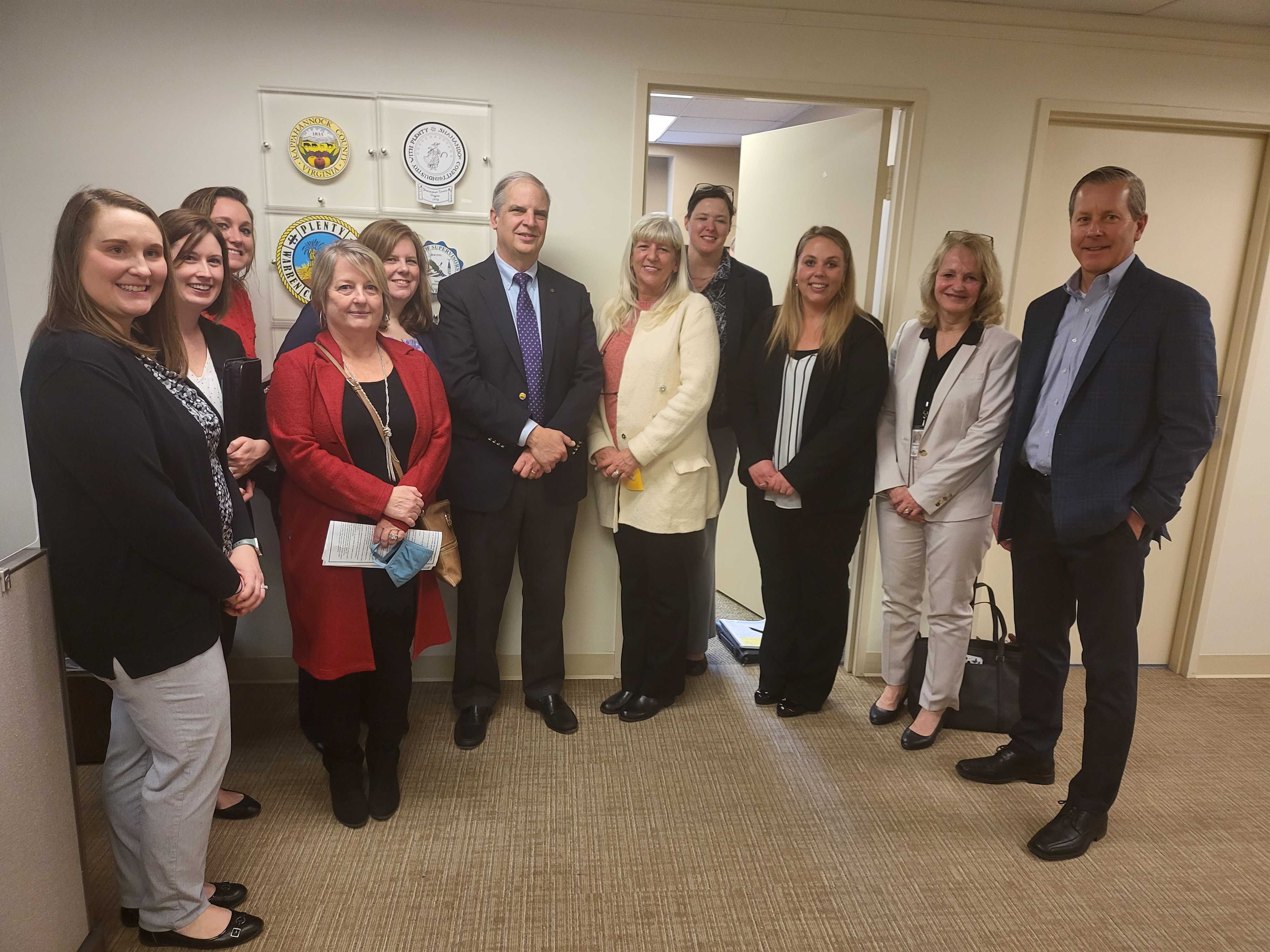
These past few weeks my office and I had the opportunity to meet with a number of visitors, including representatives of Americans for Prosperity, the Virginia Association of Realtors, and the Greater Piedmont Realtors. I also met with the General District Court Clerks in my district.

It was also Hokie Day at the General Assembly.  I met with Virginia Tech Corps Commander Major General Fullhart to get an update on the Corps of Cadets.  Coach Pry was in the house and we presented a commending resolution for VT’s 150th Anniversary on the Senate Chamber floor. Go Hokies!

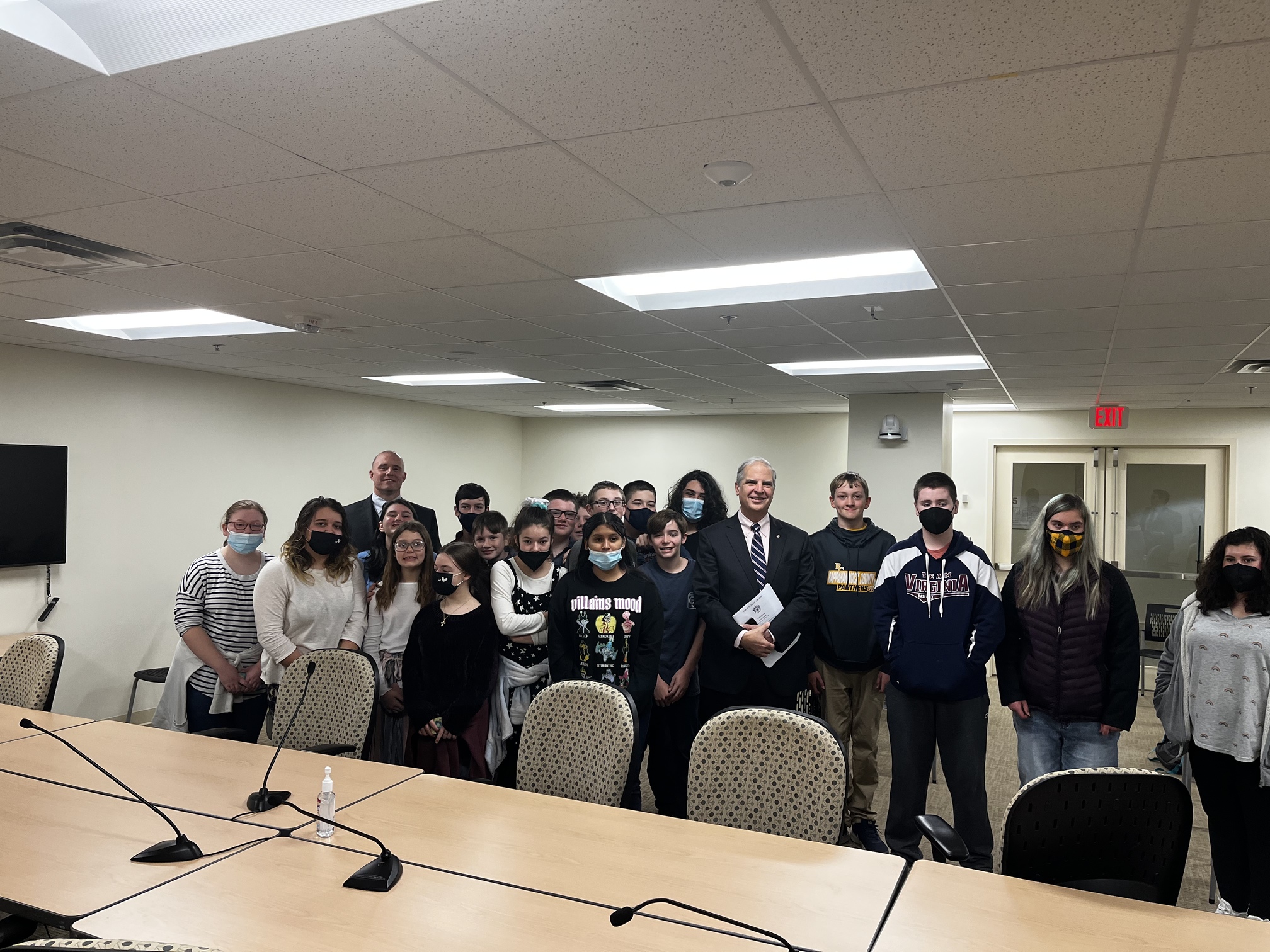
And finally, it was my pleasure to chat with students from Rappahannock Middle School in Rappahannock County.

We only have a little more than a week left in Session…it is amazing every year how time flies. As always, if you have any questions, please don’t hesitate to email me at [email protected] or come by my office in the Pocohontas building, 5th Floor, Room 502E.

Best,

Mark Obenshain

Mask Mandate Update

February 9, 2022

Friends,

One of the most highly charged political issues to emerge so far during the General Assembly Session is the statewide school mask mandate.  Governor Youngkin has endeavored to lift the mandate and to leave the choice to parents as to whether to send their children to school with a mask.  Yesterday, a large bipartisan majority approved an amendment to SB 739 that would prohibit local schoolboards from imposing a mask mandate on students or punishing students for not wearing a mask.  Republican Siobhan Dunnavant (Henrico County) and Democrat Chap Petersen (Fairfax City) joined forces and put together a coalition that advanced the bill with 29 votes in favor and only 9 in opposition.

While most legislation becomes effective on July 1, this bill will now go to the House of Delegates, where it is expected to gain swift approval.  The bill will then go to the Governor who is expected to offer an amendment that will make the law effective immediately.  This is called “an emergency clause.”  Bills with an emergency clause typically require a supermajority, however, if an emergency clause is added by a gubernatorial amendment, it only requires a majority vote by the House and Senate to approve it. 

This is good news for families across Virginia.  Even Democrat governors in New Jersey, Delaware, Oregon and Connecticut are lifting their statewide mask mandates, which may have had some impact upon the broad support the bill has received from Virginia Democrats.  The passage of this bill should put an end to the litigation filed by a handful of local school divisions challenging the Executive Order issued by Governor Youngkin in which he sought to lift the mask mandate through an exercise of his executive authority.  The legislation may be effective within the next two weeks.

Best,

Mark Obenshain

Obenshain Statement on Failure of Charter School Bill in Senate Committee

February 3, 2022

RICHMOND – Senator Mark Obenshain (R-Rockingham) issued the following statement in response to the failure of the Senate Education and Health Committee to  report the charter school bill, SB 125 on a vote of 7-8 earlier today. 

“I am extremely disappointed by our failure to pass the regional charter school bill this morning.  It is always hard for good policy to overcome political interests.   Sadly, those paying the highest price for this action are children in a handful of localities with failing schools,” Obenshain said.

“I believe all children deserve a quality education regardless of their zip code.  I consider myself an ‘all of the above’ guy when it comes to improving our education system and charter schools is just one piece of the puzzle. My bill would have extended a lifeline to areas with underperforming schools, giving parents another option for their children to receive better educational opportunities.   There are only 7 charter schools in Virginia.  To me this is completely unacceptable.  We had an opportunity today to really make a difference in the lives and education of children but due to the party line vote, the Democrats in the Senate turned their back on our children,” Obenshain added. 

SB 125 (which can be viewed here) would have created regional charter school divisions made up of two or three school divisions. A division would be eligible to participate if it meets two sets of criteria:  they have an enrollment of greater than 3,000 students and their SOL scores for English and Math in grades 3-8 are in the bottom quartile of the Commonwealth. 

45 states and the District of Columbia have charter schools.   Charter schools have only been around since the 1990s and studies show that they are most successful in school divisions that are not performing well.  They can free up constraints that have been imposed on school divisions and work “outside the box” to provide a quality education to the students they serve. 

“I will not give up the fight for education reform, charter schools and opportunities for Virginia’s children.  I believe that this will make the most difference in the lives of our children, more than anything else that we do here at the General Assembly,” Obenshain concluded.

Senator Obenshain represents the twenty-sixth district in the Virginia Senate.  The district includes the city of Harrisonburg and the counties of Warren, Shenandoah, Page, Rappahannock and Rockingham (part).  He serves on the Senate Judiciary; Commerce & Labor; Agriculture, Conservation and Natural Resources; and Transportation Committees.

###

Obenshain Releases Statement on Bridgewater College Shooting Today

February 1, 2022

RICHMOND, VA – Senator Mark Obenshain (R-Rockingham) issued the following statement today in response to the shooting at Bridgewater College.

“The events this afternoon at Bridgewater College are devastating and heartbreaking. I join countless others in our community and across Virginia as we pray for peace and comfort for the families of those affected by these events, their loved ones and for our community.

I do not know what evil is responsible for this terrible and heartbreaking event. It is clear that something is wrong in our society when tragedies like this occur. Whether it is hate, drugs, mental illness or some other underlying factor, these are urgent priorities on which we must work together. The Shenandoah Valley is a caring, God-loving and supportive corner of Virginia, but this event is a terrible reminder of the evils that can lurk in the shadows of any community,” Obenshain said.

Senator Obenshain represents the twenty-sixth district in the Senate of Virginia. The district includes the city of Harrisonburg and the counties of Warren, Shenandoah, Page Rappahannock and Rockingham (part).  He is a member of the Senate Judiciary; Commerce & Labor; Agriculture, Conservation, and Natural Resources; and Transportation Committees.

###

Opinion: Exiting RGGI is a win for Virginia producers and consumers

January 3, 2022

Gov.-elect Glenn Youngkin announced his intention to make energy more affordable for Virginians by withdrawing Virginia from the controversial 11-state Regional Greenhouse Gas Initiative. 

He recently told the Hampton Roads Chambers of Commerce he’ll remove Virginia from the initiative by executive action once he enters office in January. 

“RGGI describes itself as a regional market for carbon, but it is really a carbon tax that is fully passed on to ratepayers. It’s a bad deal for Virginians. It’s a bad deal for Virginia businesses,” Youngkin said. “I promised to lower the cost of living in Virginia, and this is just the beginning.” 

On the merits, Youngkin is correct. A timely withdrawal from this flawed carbon market, which isn’t inherently market-based, will benefit all Virginians given its vast shortcomings. 

The most notable problem with RGGI is its overall negligible impact on carbon emissions. In 2019, the Congressional Research Service observed that nine partner states “account for approximately 7% of U.S. CO2 emissions and 16% of U.S. gross domestic product” and called carbon emissions reductions “arguably negligible” at best. 

When those numbers are broken down, it only accounts for a measly 1.4% in total U.S. emissions reductions. And even this reduction is largely attributable to the transition from coal to natural gas in the state. 

Not only will RGGI membership fail to reduce carbon emissions in a meaningful way, it will raise costs for Virginians. The CATO Institute assessed electricity demand between non-RGGI and RGGI-participating states and concluded the former added more wind and solar generation than the RGGI states while having lower electricity price increases during the same time. 

When the market sets prices, demand for renewable energy naturally happens, and consumers pay lower prices for clean energy. Ultimately, the CATO Institute found “no added reductions in CO₂ emissions, or associated health benefits, from the RGGI program.” 

Virginia’s continued participation in RGGI will result in residents paying more for their electricity bills. According to recent State Corporation Commission filings, participation in the RGGI program will raise energy costs to $4.37 a month, or $52.44 per year, if enacted on Sept. 1. When paired with the new — and costly — Virginia Clean Economy Act, the net-zero law slated to raise energy bills $800 a year by 2030, this spells disaster for Virginians currently paying more to heat and power their homes. 

Additionally, as Youngkin aptly noted, RGGI levies a carbon tax on all carbon-intensive goods. This added cost associated with carbon emissions is meant to disincentivize producers and consumers from making and using carbon-intensive goods, respectively. 

But here’s the catch: Virginia’s economy, still reeling from the COVID-19 pandemic, could suffer setbacks and lose its No. 1 Top State for Business ranking if discouraged from producing carbon-based goods. Due to the demands required of RGGI, Virginia businesses could ultimately shift their operations out-of-state — or worse, overseas. That’s terrible for our state’s economy. 

RGGI proponents are similarly dishonest about the impact of carbon taxes on consumers. The nonpartisan Tax Foundation says these taxes don’t just affect producers; the costs are ultimately passed down to consumers who purchase carbon-intensive goods. When prices of goods and services increase under a carbon tax, taxpayers’ incomes reflexively diminish as well. 

Virginians would see diminished purchasing power because they already pay a premium on electricity and gas. Worse, carbon taxes would disproportionately hurt lower-income Virginia households since they rely and depend on carbon-intensive goods and energy sources for sustenance. Electricity costs would skyrocket in more economically depressed regions of the commonwealth, including southwestern Virginia. According to the U.S. Energy Information Agency, Virginia’s electric grid is primarily powered by natural gas (61%), nuclear energy (29%) and coal (4%). The reality is demand for solar and wind isn’t here yet. 

Youngkin’s critics allege he’ll upend environmental policy. But he’s on-record pledging to pursue practical all-of-the-above energy policies, coastal resiliency, and fight sea-level rise and flooding. 

Virginia shouldn’t rely on RGGI membership to achieve its emissions goals. Instead, our state can continue to innovate and develop technology — including carbon capture — without embracing more burdensome taxes and regulations. 

Gabriella Hoffman is a visiting fellow with Independent Women’s Forum and the host of the District of Conservation podcast. She lives in Alexandria.

The Jefferson Journal: How California Now Controls Virginia Auto Market

December 10, 2021

By Stephen D. Haner

12/10/2021 — Virginia’s automotive sales market is now officially controlled in Sacramento, with the likelihood that no new internal combustion engines can be sold in the Commonwealth after 2035.

The Virginia Air Pollution Control Board, acting not with discretion but on orders from the General Assembly, voted December 2 to adopt Advanced Clean Cars Program regulations that delegate ultimate control to the California Air Resources Board. Virginia will simply follow Sacramento’s lead in dictating an ever-increasing percentage of new car sales be certified as low emission or zero emission by the CARB. 

Legally it would be similar to Virginia being forced to comply with federal regulations, except these rules will come from and be amended by California and its governor, regulators and legislature. Who in Virginia gets to vote for them? No one.

Legislation in 2021 directed the Air Pollution Control Board to adopt these rules with no deference to the regulatory processes. If you missed the usual public notices or hotly-contested public hearings, it may be because they didn’t happen.  Media coverage has also been sparse.

Low emission (think hybrid) and zero emission (generally electric) vehicles are popular with many buyers already and will likely continue to be subsidized in various ways. Their prevalence was going to grow regardless. But it is California’s goal to ban the sale of internal combustion vehicles and perhaps even low emission hybrids by 2035, as expressed in an executive order from its governor.

If and when that happens, under this new regulation it also happens in Virginia. No local action is required. Perhaps that explains this ecstatic quote from the meeting reported by the Virginia Mercury:

“That is a very significant regulation. It will have a very positive impact on Virginia’s environment,” Mike Dowd, chief of the Virginia Department of Environmental Quality’s Air Division, told the board after the measure’s passage. “If it wasn’t against state personnel regulations, I’d be popping a bottle of champagne now.” 

It was the language in the 2021 bill that overrode the Administrative Process Act’s required reviews and public input that made this rocket adoption possible. That and Section 177 of the federal Clean Air Act, which made it possible for a) California to adopt fleet emissions standards more stringent than federal rules and b) other states to piggy-back on California’s program. 

The Transportation and Climate Initiative, no longer under consideration in the key states, was an effort to control the supply of motor fuels. The CARB program seeks to reduce the burning of fossil fuels by limiting the supply of internal combustion engines. A good explanation of how it works can be found here.  Several of the northeastern states that were to join TCI have already aligned with CARB before Virginia did.

The CARB program applies to the manufacturers, grants them “credits” for the sale of certified LEV and ZEV new cars, and then demands they must expend credits in order to sell uncertified cars. Over time, the number of allowed uncertified internal combustion cars is to ratchet down. If a manufacturer doesn’t need credits for gasoline cars (think Tesla), they become a commodity which can be sold for profit. 

The Virginia regulation, which can found on pages 5 through 19 of the agenda for the recent meeting, exempts the sale of used cars, transfers of existing cars, emergency vehicles, military vehicles, or a car sold in Virginia for registration in a state outside the CARB’s reach. Basically it covers new cars and light trucks under 14,000 pounds.

The General Assembly also adopted a state-funded subsidy program for the purchase of electric vehicles but didn’t identify a funding source.  With the generous customer rebates on the table, Virginia’s auto dealers joined in pushing for both the subsides and the alignment with CARB. Auto Dealers Association President Don Hall put its arguments in a guest column for the Richmond Times-Dispatch during the session, and also advocated tax-funded charging infrastructure.

“If Virginia wants to emulate California, the commonwealth also must match California’s investment. A conservative estimate of California’s financial commitment to the EV market — primarily through incentives and infrastructure — roughly is $3.5 billion,” Hall wrote. He said Virginia needs to spend $720 million over five years.

Long-term operating costs may or may not offset the bite, but these hybrid and all-electric vehicles right now sell for a premium price over internal combustion vehicles. The financial benefit to auto dealers of forcing manufacturers to build more of the former and fewer of the latter is obvious.

The expected increase in electricity demand and related transmission expansions is not exactly breaking hearts among utility executives, either.  

The added gasoline taxes from the abandoned Transportation and Climate Initiative might have paid for the proposed Virginia electric vehicle subsidies or that charging infrastructure. Governor Ralph Northam, who embraced the subsides and this delegation of regulatory control to California, has one more budget to propose next week. Massive federal funds for those purposes are part of the Biden Administration “Build Back Better” proposal languishing in the U.S. Senate.

Northam could use his budget to propose a way to start paying the subsidies with state or federal funding. It will actually be telling if he fails to do so. But no additional state funding is needed to begin to implement the California vehicle fleet rules. It would take new legislation now to prevent it. 

Stephen D. Haner is Senior Fellow with the Thomas Jefferson Institute for Public Policy. He may be reached at [email protected]

Early In Person Voting Information

September 15, 2021

While Election Day is not until Tuesday, November 2, 2021in-person early voting begins Friday, September 17th. Your in-person early voting location is most likely different from your usual polling place on Election Day. To find out more details and where you need to go to vote early in-person here is the information for the localities in my district: 

Harrisonburg 

You may vote early in City Hall (409 South Main St.) beginning 45 days before Election Day and ending the Saturday before Election Day. To vote absentee in person you must be a registered voter of Harrisonburg, provide your name and address, and show an acceptable form of ID. Early voting is open Monday through Friday, 8:30am until 4:30pm, and the last two Saturdays from 8:30am until 4:30pm.

*Curbside voting is also available in the main parking lot of City Hall. When you arrive call the Registrar’s office at 540-432-7707 to let us know that you need curbside service.

Learn more: https://www.harrisonburgva.gov/absentee-ballots

Rockingham

In-person, early voting for Rockingham County voters will be available at the locations, dates, and hours listed below beginning Friday, September 17, and ending Saturday, October 30.

20 East Gay Street, Harrisonburg 22802

Monday-Friday, 8:00 AM-4:00 PM.

This Voter Registrar’s office will also be open on Saturday, October 23, and Saturday, October 30, from 8:00 AM-4:00 PM, for in-person, early voting.

Learn more: https://www.rockinghamcountyva.gov/DocumentCenter/View/17219/Public-Notice—November-2-2021-General–Special-Elections

Page

In-person, early voting for Page County voters will be available at the following location beginning Friday, September 17, 2021, and ending Saturday, October 30, 2021, from 8:30 a.m. – 4:30 p.m. Voting will not be available on Monday, October 11, 2021, because offices will be closed due to Columbus Day.

103 South Court Street, Luray (County Government Center) lower level. Watch for signs. If you need assistance, please call 540-743-3986 and someone will be available to help you.

Learn more: https://www.pagecounty.virginia.gov/204/Voter-Registration

Shenandoah

In-person early voting will be available at the following location for the Nov. 2, 2021 General & Special Election:

Office of Voter Registration & Elections, 600 N. Main Street, Suite 103, Woodstock, VA 22644

Early voting will begin Friday, September 17 at the office and will continue Mon-Fri 8:30 AM to 4:30 PM until Oct. 30

Voting will not be available on Monday, October 11, 2021, because offices will be closed due to Columbus Day.

Learn more: https://shenandoahcountyva.us/voting/

Warren

In-person, early voting will be available at the following location for the November 2, 2021, General and Special Elections:

OFFICE OF ELECTIONS AND VOTER REGISTRATION 465 W 15TH STREET, SUITE 800, FRONT ROYAL, VA

In-Person Early No-Excuse Voting will begin on September 17, 2021 at the Office of Elections and Voter Registration. The hours are Monday through Friday from 9:00 AM – 5:00 PM, until Saturday, October 30, 2021.

The Warren County Office of Elections and Voter Registration will also be open on Saturday, October 23, 2021 and Saturday, October 30, 2021 from 9:00 AM – 5:00 PM.

Learn more: https://www.warrencountyva.net/images/VoterRegistrar/EarlyVotingNotice_November2021.pdf

Rappahannock

N-PERSON ABSENTEE (EARLY) VOTING
Located at 262A Gay Street Washington VA 22747

Monday – Friday, September 17 – October 29, 2021: 8 a.m.-4 p.m.
Saturday, October 23 & October 30, 2021: 8 a.m.-4 p.m.

Saturday October 30, 2021: Last day to vote an In-Person (early) absentee ballot at the Rappahannock County Voter Registration Office.

 Learn more: http://www.rappahannockcountyva.gov/voter.html

Other important election related dates to remember: 

October 12:  deadline to register to vote or update an existing registration

October 22:  deadline to apply for a ballot to be mailed to you. Not that your voter registration office must receive your request by 5:00 p.m.

October 30:   last day of in-person early voting

After voting against it earlier this year, Torian now says he supports repealing right-to-work

September 9, 2021

SEP 7, 2021 | VA Scope

In an election season reversal, a powerful Democrat in the House of Delegates now says repealing Virginia’s right-to-work law is a priority to him. This comes just months after he voted to kill the legislation that would have repealed the law earlier this year.

House Appropriations Chairman Luke Torian D-Prince William said in a newsletter sent to supporters on Labor Day that repealing Virginia’s right-to-work law is a priority for him. But that opportunity was before Torian earlier this year when Del. Lee Carter D-Manassas was able to get the bill on the House floor for a vote. The legislation was eventually killed on a vote of 83-13, with Torian being one of the 83 who voted against it.

The news of Torian’s reversal was first tweeted by Ben Paviour of VPM News. 

“It’s an incredible turn-around from chastising me for introducing the bill in 2019 to campaigning on it in 2021,” Carter said in an interview Tuesday. 

Carter is a self-described socialist and was defeated in his House primary earlier this summer by a more moderate candidate. He pushed for repealing the right-to-work for most of his two terms in the House. “I’m glad so many people are coming around,” he said Tuesday. 

But even after leading the charge for repealing right-to-work and losing his seat, Carter says the law still needs to be thrown out. “The law was designed to exploit racial tensions to stop working people from cooperating to fight for a better life,” Carter said. “It was terrible 70 years ago, it’s terrible now, and it’s got to go.”

Right-to-work is not a concept that is necessarily easy to grasp due to the misleading name. The law keeps unions from requiring membership at a place of employment which prevents the employees from effectively unionizing. Employees can still form a union, but they are not compelled to and employers are always free to hire non-union workers. 

28 states have right-to-work laws on the books. 

The House Republican Caucus sent out a statement Tuesday afternoon denouncing the statement from Torian. “When the Chairman of Appropriations speaks, members of the majority listen. This is a clear signal that if they hold the majority, House Democrats will push through Right to Work repeal, creating compulsory union membership for Virginians,” said Garren Shipley, a spokesman for the House Republican Caucus. “Workers who want to make their own choice on union membership should vote accordingly.”

Torian is a powerful Democrat in the House, chairing the committee that decides which legislation receives funding in the General Assembly. His campaign did not respond to a request for comment. 

The office of Speaker of the House Eileen Filler-Corn also did not respond to questions. 

“Luke Torian made clear that Virginia House Democrats are poised to repeal right-to-work if they win in November,” said Cally Perkins, a spokesperson for the Republican State Leadership Committee (RSLC). “The Democrats who voted against right-to-work repeal in February should stop pandering to their fringe base and denounce Torian’s new position.”

AFL-CIO, the largest federation of unions in the United States, says that this law makes life harder for working families. “The real purpose of ‘Right to Work’ laws is to tilt the balance toward big corporations and further rig the system at the expense of working families,” they say on their website

Torian also stated in the email to his supporters that he will prioritize paid leave for all, collective bargaining for employees, paid sick days, and increasing the minimum wage to $15/hr. He is facing a second challenge from Republican Maria Martin this November after defeating her by 47 points in 2019. 

All 100 House seats are up for election this November as well as governor, lieutenant governor, and attorney general. Early voting begins in less than two weeks on Sept. 17.