2026 General Assembly Session Wrap-Up
March 15, 2026The 2026 session of the Virginia General Assembly adjourned sine die on March 14 after a busy and often contentious 60 days in Richmond. While the legislative session has ended, several major issues remain unresolved—most notably the state budget—which means lawmakers will return to Richmond next month for a special session.
This year’s session revealed a clear divide over the direction of our Commonwealth: whether Virginia will continue focusing on economic growth, affordable energy, and responsible government—or move toward higher taxes, heavier mandates, and increasingly centralized control from Richmond.
Below is a recap of several major issues from the session.
THE BUDGET FIGHT IS NOT OVER
The General Assembly adjourned without passing a final two-year budget. The House and Senate proposals differ by roughly $1 billion, and negotiators were unable to reconcile those differences before adjournment.
What makes this particularly striking is that Democrats control the House, the Senate, and the Governor’s mansion, yet they still could not agree on a final spending plan. Much of the disagreement appears to revolve around how much more the state should spend beyond the budget that Governor Youngkin originally proposed.
One of the biggest disputes involves proposals to target Virginia’s data center industry by repealing a long-standing sales tax exemption that helped make Virginia the global leader in data center investment. Critics warn that repealing that policy could threaten billions in private investment and the substantial local tax revenues these facilities generate for communities across the Commonwealth.
These issues will now be addressed when the legislature returns for a special session later this spring.
TAXES AND THE AFFORDABILITY DEBATE
For a session that was supposedly about affordability, the result was a surprising number of new taxes and mandates that will make life more expensive for Virginians.
Republicans introduced several proposals that would have provided meaningful tax relief to working families, including repealing the grocery tax, eliminating state taxes on tips and overtime, and repealing the car tax, which continues to cost many Virginia families well over $1,000 per year.
Those proposals were rejected by the Democratic majority.
At the same time, the General Assembly advanced several policies that increase taxes or create new financial burdens:
- Paid Family Leave Payroll Tax (SB 2) – creates a new payroll tax on workers and employers, estimated at roughly $520 per employee annually.
- Mattress Tax (HB 86) – establishes a new statewide tax on mattress purchases.
- Rejoining the Regional Greenhouse Gas Initiative (RGGI) – a carbon tax program that will increase electricity costs for Virginia families and businesses.
- Statewide collective bargaining mandates – expected to increase local government spending and place upward pressure on property taxes across Virginia.
Several additional tax proposals were also introduced this year that gained national attention—including proposals that would have extended a services tax to everyday transactions such as haircuts, dog walking, and other routine services.
While those proposals did not pass this session, they clearly remain on the Democratic wish list. We will be watching closely during budget negotiations and doing everything we can to make sure they do not quietly make their way into a final budget compromise.
ENERGY POLICY: HIGHER COSTS AHEAD
Republicans introduced legislation that would have helped lower electricity bills by providing relief from mandates imposed by the Virginia Clean Economy Act (VCEA) and by encouraging the development of reliable power generation. Those proposals were rejected.
At the same time, Virginia is preparing to rejoin the Regional Greenhouse Gas Initiative (RGGI), which could impose hundreds of millions of dollars per year in additional electricity costs that will ultimately be passed on to Virginia families and businesses.
COLLECTIVE BARGAINING AND PROPERTY TAXES
Another major issue this session was legislation expanding public employee collective bargaining statewide.
Many local officials across Virginia—including many Democrats—have warned that the policy will dramatically increase local government costs. Fairfax County is already facing a $300 million budget deficit, and Richmond has also reported major personnel cost increases after adopting collective bargaining.
Despite these warnings, the General Assembly moved forward with the mandate.
The law delays full implementation until 2028—after the next General Assembly elections. The cynical hope appears to be that voters will not fully realize the consequences, particularly the inevitable increase in property taxes, until after those elections have already taken place.
Given the experience of localities that have already adopted collective bargaining, moving forward with a statewide mandate seems to reflect an aspiration for the triumph of hope over experience.
CHILDREN, FAMILIES, AND THE SANCTITY OF LIFE
Perhaps the most significant issue in this area is the proposed constitutional amendment on abortion that will appear on the ballot in November. Despite misleading claims that it simply restores the legal framework that existed under Roe v. Wade, the amendment goes much further and could invalidate widely supported laws such as Virginia’s parental consent and parental notification requirements.
Other legislation debated this year included the Youth Health Protection Act to prevent gender transition procedures for minors and legislation protecting girls’ sports by reserving female teams for biological females. Both were defeated.
One issue where we were able to prevail this session was defeating legislation that would have legalized assisted suicide in Virginia. Physicians testified about the risks and abuses seen in other states. Defeating this legislation was a rare win this year for those who believe in protecting the sanctity of innocent human life.
REDISTRICTING AND THE ‘LOBSTER DISTRICT’
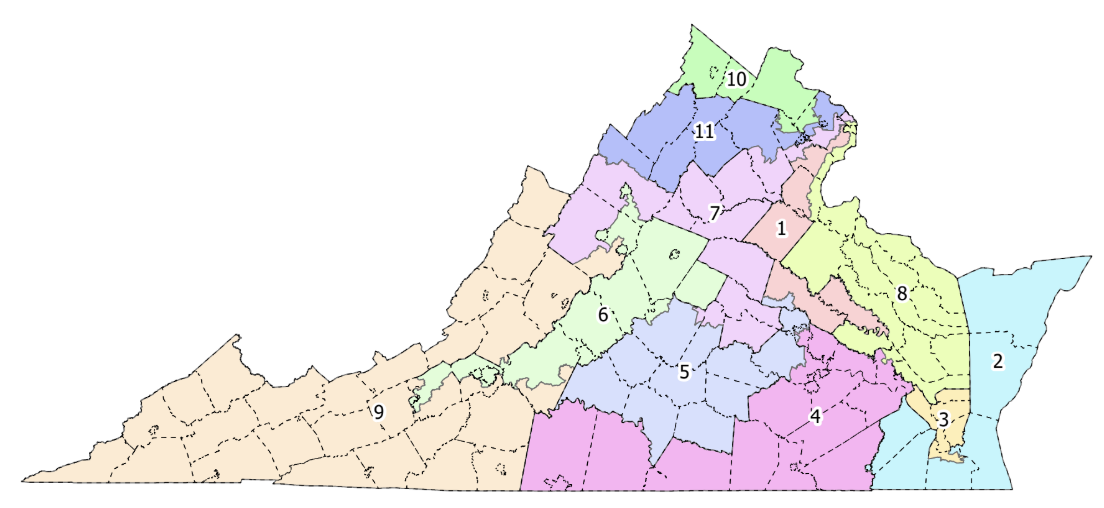
Democrats have already produced congressional maps that stretch the limits of common sense. One proposed district—the 7th Congressional District (which includes the area I represent and live)—runs from western Augusta and Rockingham Counties north to Falls Church and Arlington, then south through Goochland, Powhatan, Buckingham, and Cumberland.
Observers have described the shape as looking like a lobster.
Former First Lady Dorothy McAuliffe has already entered the race for the district with endorsements from Nancy Pelosi and other liberal political icons.
This highlights the importance of the April 21 referendum on redistricting. Early voting is already underway, and I strongly encourage everyone to participate.
Voters in the Shenandoah Valley are not going to allow Democrats to force us to trade a great conservative congressman like Ben Cline for a hand‑picked liberal like Dorothy McAuliffe without a fight.
SECOND AMENDMENT ISSUES
Democratic majorities advanced multiple bills imposing new restrictions on law‑abiding gun owners, including magazine limits, age restrictions, and new storage mandates.
They even imposed criminal penalties for leaving a firearm in a vehicle while simultaneously expanding the number of places concealed carry permit holders cannot legally carry.
It was particularly revealing when Democrats attempted to sneak in an exemption for members of the General Assembly parking in the General Assembly parking garage, highlighting the hypocrisy of the proposal.
I previously sent a detailed update on these issues and will send a follow‑up soon summarizing the final legislation.
ELECTION LAW CHANGES
Several significant changes to Virginia election law were adopted this session.
Many of these policies prioritize convenience but risk undermining public confidence in the fairness and integrity of elections. Republicans argued that elections should be free, open, and fair—ensuring both participation and trust in the process.
A VERY IMPORTANT WEEK IN APRIL
April 21 – Redistricting Referendum
Virginians will vote on a constitutional amendment that effectively reverses the anti‑gerrymandering reforms approved in 2020 and allows Democrats to impose a heavily gerrymandered congressional map expected to produce a 10‑Democrat to 1‑Republican delegation.
I strongly encourage voters to turn out and vote NO.
April 22 – Veto Session
Governor Abigail Spanberger will have the opportunity to keep her campaign promises of moderation—or sign the many partisan bills currently sitting on her desk.
April 23 – Special Session on the Budget
The General Assembly is expected to reconvene to finalize the state budget.
LOOKING AHEAD
If you have questions or opinions about these issues—or any other matters addressed during the General Assembly session—please do not hesitate to contact my office. Hearing directly from the citizens I represent is always invaluable.
Thank you for the privilege of representing you in the Virginia Senate.