The General Assembly Week 4 Wrap Up
February 16, 2026Dear Friend,
As we enter the fourth week of the 2026 General Assembly session, I want to provide my legislative report on what is happening in Richmond. Governor Spanberger campaigned as a moderate and made “affordability” her central promise. The actions we are now seeing—by the Governor and her Democratic allies in the General Assembly—tell a very different story.
This is an affordability bait-and-switch.
RGGI: A Back-Door Carbon Tax
In her first State of the Commonwealth address, the Governor announced that Virginia will be forced back into the Regional Greenhouse Gas Initiative (RGGI). RGGI is a multistate cap-and-trade program that operates as a back-door carbon tax, with the stated goal of reducing emissions by 86 percent by 2037, regardless of cost or reliability.
According to the Thomas Jefferson Institute for Public Policy, re-entering RGGI will cost Virginia electric customers approximately $500 million every year in higher power bills. That burden will fall directly on families and small businesses—at the same time Virginia is struggling to meet rising electricity demand from data centers and advanced manufacturing.
Immigration: Ending Cooperation with ICE
On immigration, the Governor has aligned Virginia with the national progressive agenda. She ordered state police and corrections agencies to terminate all cooperation agreements with federal Immigration and Customs Enforcement.
This is not moderation or bipartisan governance. It is ideological posturing that abandons cooperative federalism and undermines public safety.
Redistricting: Reversing the 2020 Voter Mandate
Redistricting represents one of the most cynical and hypocritical political moves in modern Virginia history. On November 3, 2020, Virginia voters overwhelmingly approved a constitutional amendment creating a bipartisan redistricting commission, explicitly rejecting partisan gerrymandering and demanding fairness and transparency in the process. That vote was clear, recent, and decisive.
Now—barely five years later—the Governor and Democratic leadership are backing a constitutional amendment designed to blow up that bipartisan system and return redistricting power to the General Assembly for raw partisan advantage.
Last Thursday night, Democrats released a proposed congressional map that confirms exactly what this effort is about. The districts are anything but compact and bear no resemblance to communities of common interest.
2026 Democrat Proposed Congressional Map:
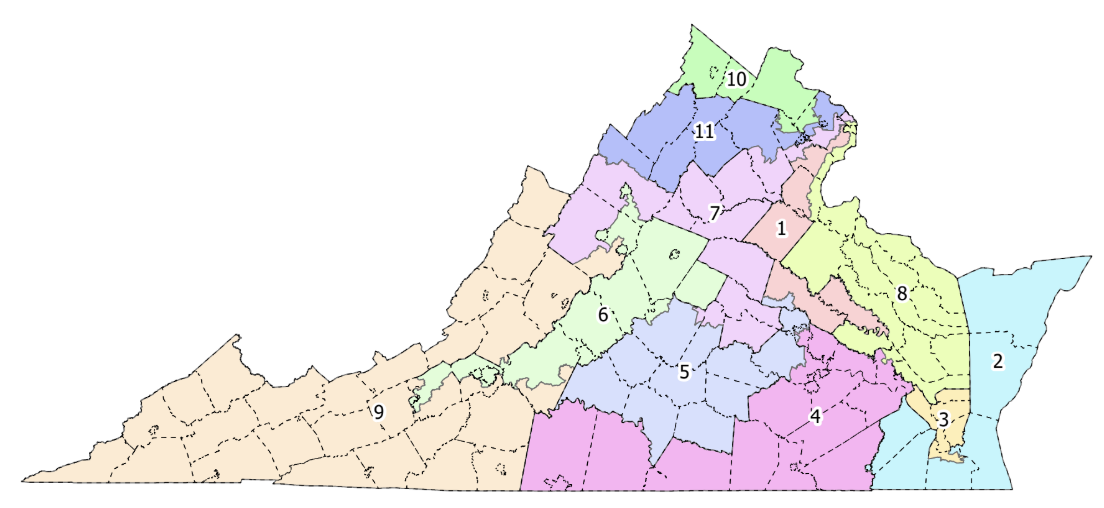
Rockingham County alone is split into three different congressional districts, and northern Rockingham is shoved into a district that stretches all the way to the Potomac River near Washington, D.C. This is gerrymandering, plain and simple—and a direct slap in the face to Virginians who were told in 2020 that partisan map-drawing was over.
Higher Education: Politicizing Virginia’s Institutions
Higher education has also become a battleground. While the Governor herself did not initiate it, her legislative allies have launched an ongoing campaign against the Virginia Military Institute, the oldest state-supported military college in America and one of the most distinguished military academies in the nation.
VMI’s alumni include George Patton, George Marshall, and numerous Medal of Honor recipients. Yet we are now seeing open hostility toward the institution’s mission, traditions, and leadership—boards at UVA and George Mason University are being politicized, and divisive DEI bureaucracies are being revived across higher education.
Taxes: A Wish List of New Burdens
The tax agenda may be the clearest example of the bait-and-switch. Despite a $2.7 billion budget surplus, Democrats have rolled out what can only be described as a wish list of new taxes. These include higher income-tax brackets, a new tax on investment income, and a statewide paid family and medical leave program funded by a new payroll tax.
Under current estimates, a two-income family would pay more than $500 per year in new payroll taxes alone, not including the employer share—which will inevitably be passed back to workers through lower wages, higher prices, or both.
As the Washington Post recently noted, Virginia is not suffering from a revenue shortage. Income tax collections have exceeded projections year after year, taxpayers have received rebates, and the Commonwealth maintains a multi-billion-dollar rainy-day fund.
Democrats insist that because not every tax proposal has passed yet, critics are exaggerating. That argument is not credible. These proposals did not appear by accident. They are part of a broader plan—and any that do not pass this year will be back in future sessions.
Right-to-Work: Being Gutted in Practice
Finally, while the Governor claims she does not support a full repeal of Virginia’s Right-to-Work law this year, she and her Democratic allies are gutting it in practice.
They are advancing statewide collective bargaining mandates and prevailing-wage laws that will balloon local government budgets, drive up real estate taxes, and significantly increase the cost of building schools and colleges—raising the cost of higher education itself.
There is nothing affordable about any of this.
Virginians were promised moderation, bipartisanship, and affordability. What we are getting instead is a progressive agenda that raises costs, centralizes power, and disregards the clear will of the voters.
I will continue fighting these policies and standing up for common sense, affordability, and honest government. As always, I welcome your thoughts—and if you are in Richmond during session, please stop by my office.
Further Reading
- Wall Street Journal editorial on Governor Spanberger’s early agenda: [Link]
- Washington Post editorial on Virginia’s surplus and proposed tax hikes: [Link]
- Virginia Mercury article detailing Democrats’ proposed tax increases: [Link]
Sincerely,

Mark Obenshain


